
GROUNDWORK Ed.14
THE ART OF OBSERVATION
A reflection on Piet Oudolf x De Bloeimeesters, a beautifully filmed conversation between Piet Oudolf and landscape architect Arjan Boekel, created by De Bloeimeesters
Whenever Piet Oudolf speaks, we pay attention. For decades, Piet has shaped the way we think about planting. His work, from the High Line in New York to public landscapes and private gardens across Europe, has influenced generations of landscape architects, designers and gardeners. So when De Bloeimeesters released this new documentary, we were eager to spend time with it.
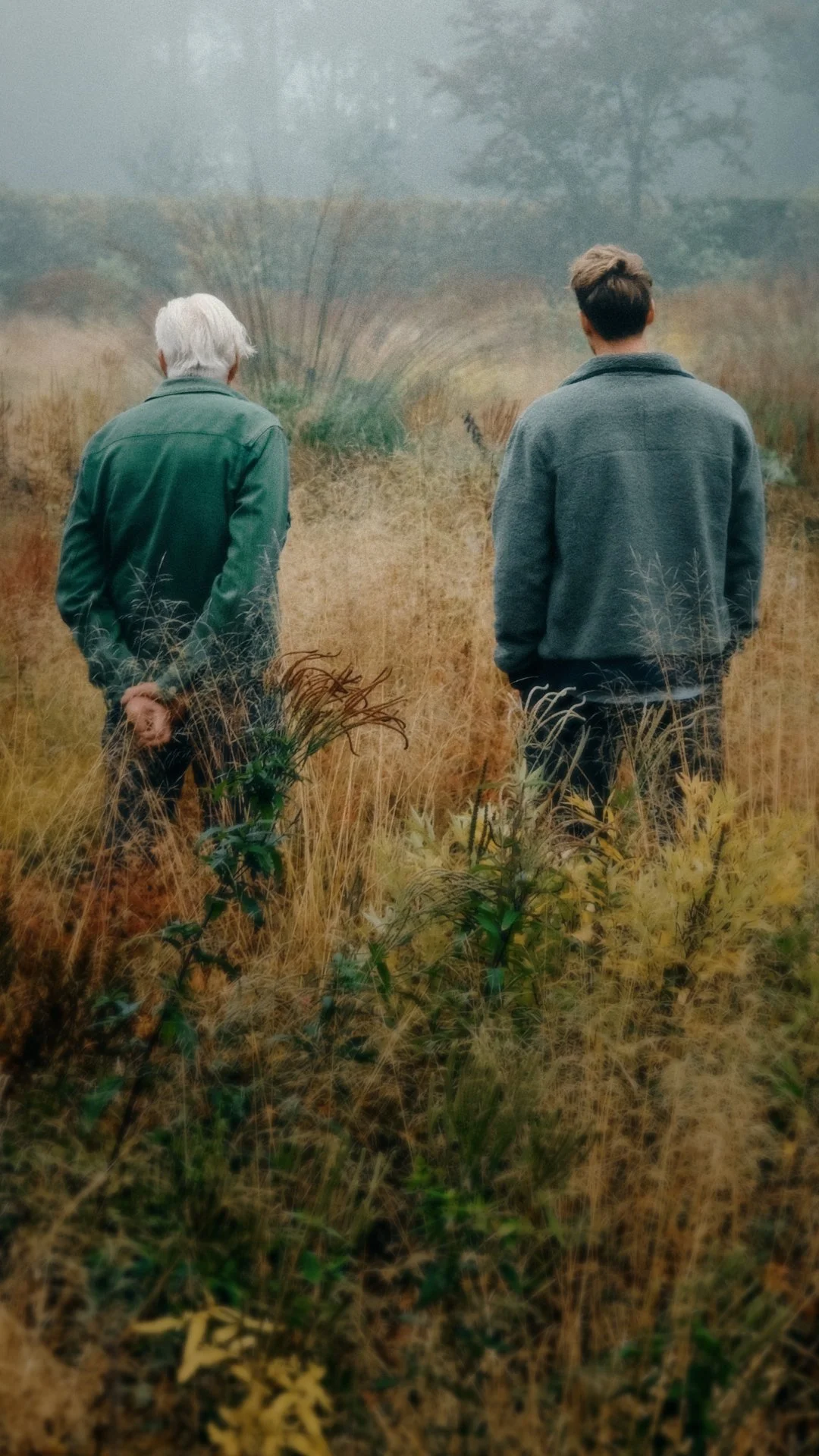
The film opens on a cold winter morning in Piet's garden. Mist hangs low across the planting. Seed heads catch the light. Piet and landscape architect Arjan Boekel wander slowly through the garden, stopping often to look, reflect and notice. It feels less like an interview than an invitation to observe alongside them.Their conversation is centred on a return to Piet’s home garden, ‘Hummelo’. They notice where flooding has changed the planting. They talk about species that have disappeared, others that have quietly taken their place, and how the garden continues to evolve more than a decade after it was first established.Piet describes his role now as guiding the garden rather than trying to control it. He still edits, still removes plants, still makes decisions, but his practice has shifted towards observation. The garden reveals itself over time, and his role is to pay attention.
At Super Bloom, we often speak about planting as something that continues long after installation. The planting plan is only the beginning. Every season brings new information. Plants establish, compete, self-seed, retreat and surprise us. Returning to a landscape becomes just as important as designing it in the first place, because every return offers another opportunity to learn.
Arjan brings another perspective to the conversation through his work in the public realm. Together they reflect on how these ideas sit alongside the practical realities of contemporary landscape projects, where maintenance, procurement and policy all influence what is possible. It is an honest discussion about the difference between designing a planting and caring for one over time.
Perhaps practice is found in the act of returning. Returning to the same place, season after season, with enough curiosity to notice what has changed, enough humility to learn from it, and enough care to respond.
Watch now: Piet Oudolf x De Bloeimeesters
Credits: De Bloeimeesters, Generatie Alles, Arjan Boekel, Piet Oudolf
PIET OuDOLF X DE BLOEIMEESTERS
INTERVIEW WITH ARJAN BOEKEL
In The Future of Plant Knowledge in Public Realm, you and Piet Oudolf discuss how his garden has changed over time, with some plants disappearing, others taking over and new relationships emerging. What does this tell us about the nature of planting practice?
It shows that planting is never a finished composition. It is a continuing process in which plants compete, disappear and form new relationships. The role of the designer is therefore not only to compose, but also to observe and guide change. You are truly starting up a system, instead of delivering a finished installation.
Piet speaks about the importance of continually observing and “editing” a garden over time. How has the process of observation shaped your own practice, and how do you decide when a planting needs intervention and when it needs time?
Observation has taught me to look beyond the original plan and understand what the planting itself is communicating, where it 'wants' to go. I intervene when one species begins to reduce the diversity or spatial clarity of the whole, but that's tricky, because at first it might look good when a plant is successfully spreading, but after a while it might reach a tipping point when it becomes too dominant. That often happens with early flowering plants that don't look good after flowering. A key learning of observation is that you judge a planting but in the meantime you always look into the future. The future of the next season and the following year. But temporary imbalance is not necessarily a problem; sometimes a planting simply needs time to find its own equilibrium. Pioneer species will ramble, but the more solid perennials won't be pushed away.
Every landscape begins with an idea, but plants have their own timelines, behaviours and responses. How do you approach the relationship between your original design intention and the way a landscape evolves?
I see the design intention as a direction rather than a fixed final image. The spatial structure and atmosphere should remain recognisable, but the precise expression can change as plants respond to the conditions and to each other. A successful planting can evolve without losing its identity. The change is gradually, does not come in shockwaves. Trees and shrubs grow and add more shade, pioneer species will fade out as longer loved perennials take up more space. It's natural succession.
Much of planting design happens within what you describe in the film as the “paper reality”, plant schedules, specifications, permits and requirements. How do you maintain the spirit of a planting concept while working within these practical frameworks?
This is so tricky and it gets me wired up. The “paper reality” is a necessity for bureaucratic 'measurability', especially in public projects. The problem is that it can never fully describe a living planting. I try to protect the central spatial and ecological principles while remaining flexible about individual species or quantities. It is important that everyone involved understands the intention behind the plant list and spatial layout, not only the list itself. I must admit that a lot of the paper reality is about getting the permit. Whenever you pass you can do whatever you want because no one checks. And if it's checked just after installation, what does it really say? When you start up a system, a living macro organism that a planting really is, when should you measure that '40% of the planting is native plants'? Do you cut them and weigh? Do you count the amount species per square meter? Do you measure the amount of plants per square meter? Do you double count big plants over a single count for a seedling? Do you count in spring, when you don't even see the later emerging species yet? Do you count in summer of autumn, when the spring ephemerals are already dormant? Do you count insect species? Ok, did you do a measure before the planting got in, so you can track the change? Do you incorporate the surroundings and change of the surroundings into the measuring? Good luck with that! Look, I'm all in favor for implementing native species in our plantings, but don't pretend that it's all measurable. We work outside, not in a laboratory. At best, you can measure by intention. In Arnhem we seeded most natives, because if you plant them at an equal level as the 'non-natives', they tend to take over a planting and species that take slower to emerge and develop. If you seed in, the natives emerge and blend in more slowly, rather than taking over. Some of the more rampant species - if needed anyway - should be introduced later on, maybe after 1 or 2 years. Again, good luck measuring that. Planners: zoom out, don't lay all the requirements that you would like to see in a system on the scale of a city or region onto one plot. That's a paper reality and it does more harm than good.
Your work often involves designing landscapes that respond to complex ecological relationships, including projects where planting needs to accommodate animals such as bison moving through the landscape. How does working with these living systems influence the way you practiCe?
hat comment about bison and wild cows was a joke . But as Peter Korn famously said: 'disturbance is good'. A planting (especially a perennial planting) is a very dynamic thing. Once the pioneers are faded, pushed aside by the longer lived species, we can only keep the perennial and grassy stage if we humans intervene. Otherwise in our part of the world, the planting will become grasses and shrubs, shrubs and trees and in the end climax vegetation: dense forest. We are the bison! We graze, we pull out weeds, we pull out tree seedlings, we disturb. Creating room for the desired species, creating uncovered soil in which pioneers germinate. Looking at living systems changes how you see a landscape or a planting. The most colorful plantings in 'nature' often are man-made landscapes: hay land that is yearly mown or extensively grazed. Amazing vegetations, very rich in species. Fallow arable land, 3-4 years after being cultivated, real color explosions. I've seen those landscapes, in steppe regions like Kyrgyztan, Armenia, or in the Balkan countries like Slovenia. They are everywhere where a delicate balance still exists between human intervention and natural succession. In western Europe those landscapes are mainly gone because of mass monocultural agriculture. Only in difficult to farm places like higher up in the mountains, on steep slopes, in wetlands, or very dry area's. Places that are not suitable for mass agriculture.
A planting practice develops through years of watching, testing and learning. What are the observations or experiences that have most shaped the way you approach planting today?
All of the mentioned above! And it's a mix of watching and listening to key figures like James Hitchmough, Peter Korn, and other plant people who are experimenting and pushing the boundaries. But as always, for my own projects the failures have learnt me more than the successes. And the successes will also quickly fail after a couple of years, when there is no vision behind the guidance ('maintenance') or just a lack of guidance. Perennial planting is a temporal thing. Trees and shrubs are here to stay for a longer time. Repeated observation over several seasons is essential.
In naturalistic planting, plants are understood as communities that change and interact over time. How has this way of thinking influenced the way you create planting palettes and make decisions about which plants belong together?
I no longer select plants only for their individual qualities, but also for the roles they can play within a community. I consider their growth strategy, lifespan, seasonal rhythm and ability to coexist. The palette becomes a network of relationships rather than a collection of attractive species. I try to build up a (loose) structure of long living perennials, bigger solitary species like Baptisia and large grasses. They are selected for individual qualities, like structure before, while and after flowering. Repeating them for a sense of rhythm, structure and 'readability'. Actually all things that Oudolf have learned to me in his books. Small shrubs are increasingly within my scope of interest for this use. In between these clumps or clusters, I tend to let go of the structure and the fixed outcome. I'm cooking with randomly mixed ingredients. Composing plant lists of plants that go well together, adding percentages and numbers and scatter them loosely into the planting, mostly in drifts. Those drifts are also repeated, but in a more 'loosely' structured repetition that you only might sense in a more unconscious way.
Public landscapes require practitioners to think beyond the moment of installation and consider decades of growth, management and change. How do you design with time as a material in your practice?
I design for several moments at once: establishment, early abundance and longer-term succession. This means anticipating which species will appear quickly, which will provide continuity and how management can guide the transition between phases. Time becomes part of the composition.
As climate, ecology and the expectations of public landscapes continue to evolve, how do you see planting practice changing in the coming years?
Planting practice will need to become more adaptive and more grounded in ecological knowledge. Climate change makes fixed recipes increasingly unreliable, while public landscapes are expected to provide beauty, biodiversity and resilience simultaneously. Designers will need to work more closely with growers, ecologists and maintenance teams. On a more practical note, I think for the public realm in Western Europe, we will see more woody vegetations and less flower bedding and perennial plantings. Woody vegetation is, in general, longer-lived, creates shelter and shade, cools our cities, and filters our air better than perennial plantings can do. The underlayer can consist of shade-loving perennials and shrubs. A system like that is more stable over time, requires less maintenance and serves more goals. As a planting designer that first fell in love with perennials, that is quite a shift, but one I fully support, investigated in and has gradually grown on me for the last 15 or so years.
Looking back at your own journey as a practitioner, what continues to surprise you about working with plants? And what questions are you still exploring?
Plants continue to surprise me in the way they can respond differently to very small changes in soil, climate or competition. I am still exploring how succession can be used deliberately without making planting either too controlled or too unpredictable. For me, the most interesting question is how design can give direction to a living system while still allowing it freedom.